

By Dr Dave Aplin.
I would wager that if you knew 200 distinct types of plant, not including cultivars, then you will know the majority of plants encountered in residential gardens. A walk down any street where you can peer into gardens, and you are likely to come across broadly similar plants. Some of the most popular include: Californian lilac (Ceanothus), hydrangea, spotted laurel (Aucuba), flowering current (Ribes), lily of the valley bush (Mahonia), Viburnum and dogwood (Cornus). There is of course good reason, these plants do especially well and are easily purchased from garden centres. They are relatively straightforward to propagate in large numbers, thus reducing costs to customers.
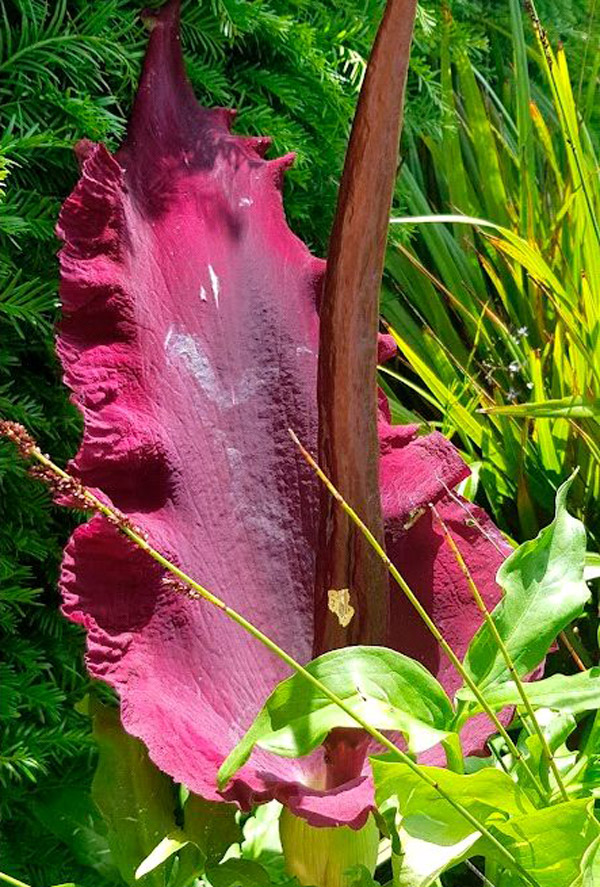
And yet, there are thousands of different plants that could grace your plot. The development of the internet and online databases has allowed us to expand our plant knowledge and locate something a little different from the usual suspects. We have a south-facing border where I grow plants that are a little less mainstream. These include the dragon arum (Dranunculus vulgaris) that produces a magnificent one metre tall flower that smells of rotting flesh and attracts pollinating flies, although it is rather unfortunate that it tends to bloom on my wife’s birthday! Nestling beside the dragon arum is a hardy relative of the pineapple, Ochagavia from central Chile. It’s a dramatic plant with vicious leaves grown for its spectacular flowers, although a decade on I still await them.
I don’t have room for many additional plants in my border, so I am very selective. However, on Monday I spotted a Canary Island bellflower (Canarina canariensis) flowering outside at Abbotsbury Subtropical Gardens. I had previously seen it growing in the laurel forests on Tenerife and had forgotten how attractive their flowers are. This plant is considered tender, but with my garden’s sheltered southerly aspect I was motivated sufficiently to give it a go…if I could find it.
It would never be available from a garden centre, so an independent nursery was my only option. A few years ago, searching for unusual plants would have been a daunting task. Today however, with a bit of luck, you are just a few clicks away for finding what you want. The Royal Horticultural Society (RHS) manages a freely accessible database ‘Find a plant’ with over 10,000 plants listed and where to buy them. Armed with the database at my fingertips I set about discovering if Canarina was available to purchase and if so, could I obtain it through mail order? I discovered four nurseries listing it in the UK, some were sold out, but one, Treseders Nursery in Cornwall, had stock for £6 each and happy to despatch via mail order. I ordered two plants, one to take its chances on our south wall, another to mollycoddle as an insurance policy if freezing weather arrives. On Wednesday, I received the plants in perfect condition and planted them out. Obtaining this plant was literally that easy, the hard part will be the plant’s realisation that they have to face the Dorset climate rather than Tenerife’s.






Leave a Reply